Suitable for high yield environments in Rabi Season
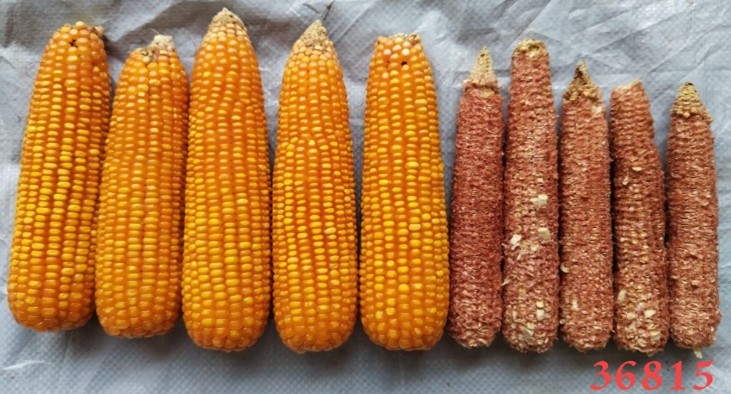
Grain Colour
Orange Yellow
Grain Texture
Semi Dent
No of Rows:
12-14
Shelling%
80%-82%
Recommended Geography
Rabi sowing areas of Bihar,West Bengal, Jharkhand , MadhyaPradesh ,Maharashtra,
Key Features
Suitable for close spacing sowing
Earliness – Early to harvest
Highly consistent and stable
Attractive orange yellow color grain
Excellent cob uniformity
Stalk Rot (PFSR) Tolerance
Good heap appeal
Capacity of Producing productive double cob in wide spacing
Technical recommendations
Selection of Hybrids
Select the best and High yielding Rabi Hybrid suitable for respective location
Selection of Lands and Preparation
Select the levelled suitable heavy or light soil with good water holding capacity and proper drainage to avoid excess of water stagnation.
Follow the sowing method either Flat bed (Bihar) or ridge and furrow (Odisha, West Bengal, Chhattisgarh) or line sowing / Zero tillage (Coastal AP) or Paired row Madhya Pradesh, Maharashtra based on respective local practice
Space recommendation for Bihar : row to row 50cm and plant to plant 18cm
Space recommendation for Andhra & Telangana :
For Zero tillage : row to row 60cm and plant to plant 20cm-22.5cm
For line sowing : row to row 60cm and plant to plant 20cm
Space recommendation for Madhya Pradesh & Maharashtra : row to row 60cm and plant to plant 20cm
Application of Organic Fertilizers
Application of farm yard manure at 6-8 ton per acre
On Farm seed treatment
Treat seed with Cyantraniliprole 19.8% + Thiamethoxam 19.8% FS @ 6 ml/kg seeds. Seed treatment protects against Fall Army Worm (FAW)at early crop stage and helps to maintain plant population.
Sowing
Sowing will plan between November to December.
Always take shallow depth sowing depth for good germination but sandy soil needs to increase the depth of sowing.
Maintain Good moisture level for better seed gemination.
Note:
Application of Zinc sulphate should not be mix with DAP or any other fertilizer.
5Kg of Zinc sulphate should be mix with 8-10Kg of soil and apply for 1 acre of field.
Application of Micronutrients 5kg/acre is essential if soil was deficient of micronutrients
For better crop establishment at initial stage, recommend to apply 19:19:19 @ 1% solution (1 kg per 100 L of water) at 20days from the date of sowing.
Soil testing is recommended to understand residual nutrition and to apply fertilizers accordingly based on the test results.
Weeds Management and Inter cultivation:
Application of Pre-emergent Herbicide is essential to protect from weeds at early stage: Atrazine (50% WP) @ 400-800 gms/acre based on the weed intensity
Atrazine & Surfactant spray can be applied as per specific company instruction.
Need to protect the crop by manual weeding followed by earthing up for better protection from weeds.
If there is a difficulty in Manual weeding then go for post emergent herbicide: Tembotrione (Laudis) @ 150ml/Acre or Topramezone (Tynzer) @ 30ml/acre (Use the instruction recommended by the specific company).
Critical stages for Irrigations:
Seedling stage
Knee-height stage
Flowering stage
Grain filling stage Note: In case if the soils are heavy, irrigation should be light & frequent. However, adjust the number of irrigations based on environmental conditions.
Pest Management: (Major pest: Fall Armyworm (FAW) & Stem Borer)
For control of Fall Armyworm: Spray of Spinetoram (Delegate) @ 200 ml per acre in 200 L of water. For better control of FAW always spray the chemical to Whorl of corn plants .
Stemborer: Thiamethoxam 12.60% +Lambda-Cyhalothrin 09.5% ZC (Alika 247 ZC) ,Dosage to be as per company instruction
Seed treatment with T. harzianum (6 g/kg of seeds) +
Azoxystrobin 18.2% + Difenoconazole 11.4% SC =Amistar Top 1 ml per Liter
Apply at flowering stage or early symptom appearance for maximum effectiveness
Harvesting:
Check the black layer formation in grain before harvest
Harvest at <25% moisture in grain and later dry at proper condition to reduce the grain moisture level
Precautions:
During flowering, the maize crop is highly sensitive to prolonged extremely low temperatures below 10°C and extremely high temperatures above 35°C. Farmers are advised to plan their sowing schedule according to the weather forecast to avoid poor grain filling. Proper irrigation during the flowering stage reduces losses and helps minimize the adverse effects of extreme temperature conditions on the crop